


Fork Positioners
Your Professional Fork Positioners Supplier
Our goal is to become your true partner in the field of fork positioners in China. Xiamen Wontonne Tech Co., Ltd. Leveraging 20 years of expertise, Wontonne Forklift Attachments has excelled in advancing the efficiency and versatility of forklifts. We have a skilled engineering team dedicated to refining every stage, from product development and process improvement to production oversight, ensuring every product delivered meets rigorous quality and performance standards. The price is competitive and the product is quality-assured, which is a good choice for your long-term cooperation.


Why Choose Us
Our team: We have a team of more than 110 well-trained employees, including 25 sales engineers and 10 senior engineers.
Our certifications: We have patent certificates, CE certificates, ISO 9001 certification certificates, etc.
Short delivery cycle: We provide next-day delivery service for stock products, 7-10 days delivery service for standard models, and 20-30 days delivery service for customized products.
Our services: In the pre-sales stage, our team of experts will recommend the most suitable products according to the needs of customers and provide detailed technical consultation. During the sales period, we ensure timely delivery and provide installation guidance. For after-sales, we provide long-term technical support, warranty services and spare parts to help customers maximize the use of products and get reliable maintenance during use.
Advantages of Fork Positioners
Time savings
Because operators will not have to adjust the forks manually, processes can move faster, allowing businesses to maximize their time. Fork positioners are quick and easy to swap in and out, too.
Less risk of damage
The fork width will match the dimensions of a pallet, decreasing the chances of human error that might cause damage.
Increased safety
Fork positioners automate the adjustment process, which means operators don’t need to do it themselves. This change poses less risk of injuries.
Lowered costs
When businesses purchase the right forklift fork positioners, operators can do more work with less time and effort. The added efficiency can contribute to lower labor costs over time.
Types of Fork Positioners
Hydraulic fork positioners
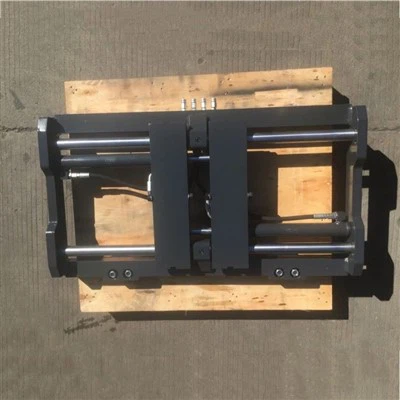
Hydraulic fork positioners are among the most common and widely used. They utilize hydraulic power to smoothly and precisely adjust the fork width. These are suitable for a wide range of forklifts and offer excellent control and accuracy.
Mechanical fork positioners
Mechanical fork positioners rely on manual mechanisms, such as hand cranks or levers, to adjust fork width. While they May require more effort from the operator, they are often a cost-effective choice and can be found on some forklift models.
Integral fork positioners
These fork positioners are integrated into the forklift’s carriage assembly. They eliminate the need for external attachments and provide seamless fork adjustment. Integral fork positioners are commonly seen on specialized forklifts designed for specific tasks.
Sideshifting fork positioners
In addition to horizontal fork adjustment, sideshifting fork positioners allow lateral movement of the forks. This lateral movement is invaluable when it comes to precisely positioning the load without moving the entire forklift.
Specification of Fork Positioners
|
Capacity |
Load Center |
Model No. |
Mounting Class |
Opening Range |
Min.Truck Carriage Width |
Carriage Width |
Fork Porket Width |
Vertical Center of Gravity |
Horizontal Center of Gravity |
Weight |
Effective Thickness |
|
kg |
mm |
|
|
O |
|
W |
B |
VCG |
HCG |
M |
ET |
|
mm |
mm |
mm |
mm |
mm |
mm |
kg |
mm |
||||
|
2500 |
500 |
FPD25E-1040A |
ISO 2A |
|
940 |
1040 |
120 |
206 |
45 |
130 |
99 |
|
3000 |
500 |
FPD30E-1100B |
ISO 3A |
|
1000 |
1100 |
125 |
261 |
47 |
153 |
105 |
The fork positioner is a versatile and essential forklift attachment designed to enhance the efficiency and safety of material handling operations. This innovative attachment allows forklift operators to adjust the distance between forks hydraulically, providing greater flexibility and precision when handling loads of varying sizes. The fork positioner is ideal for applications in industries such as warehousing, logistics, manufacturing, and distribution.
The e-series fork positioner allows for independent control of each fork, requiring two additional hydraulic circuits.

Application of Fork Positioners
Warehouse and distribution centers
In the warehouses and distribution centers, rotating fork positioners have a place as they provide good control of the forks when handling various types of cargo. They help in the precise placement of the material in rack systems, thus minimizing damage to the products during storage.
Manufacturing industries
Rotating fork positioners are useful in many manufacturing industries to enhance the assembly and handling of raw materials. The positioners are tailored to handle items of different sizes more easily and safely during the feeding and transferring process on the production line.
Construction sites
Construction sites make good use of hydraulic or pneumatic rotating fork positioners. This is because such environments require tools that can perform very heavy duties, and positioners are perfect for moving construction materials like steel beams, concrete blocks, and other bulky items.
Cold storage and refrigeration
Rotating fork positioners find purpose in cold storage facilities and refrigerated transport. They are most often fitted with special forks or fork tines coated with non-abrasive materials. It allows for the handling of perishable produces like fruits and vegetables gently, thus prolonging its shelf life.
Retail and logistics
Positioners in the retail sector have a crucial role in transporting crates, shelves, and merchandise stored in stockrooms. The adjustability of the forks allows for the handling of objects like furniture, employing the positioners to ease transportation.
Packing and Shipping of Fork Positioners
|
Packing |
Wooden box |
|
Shipping |
Shipped by road, sea, rail |
FAQ